
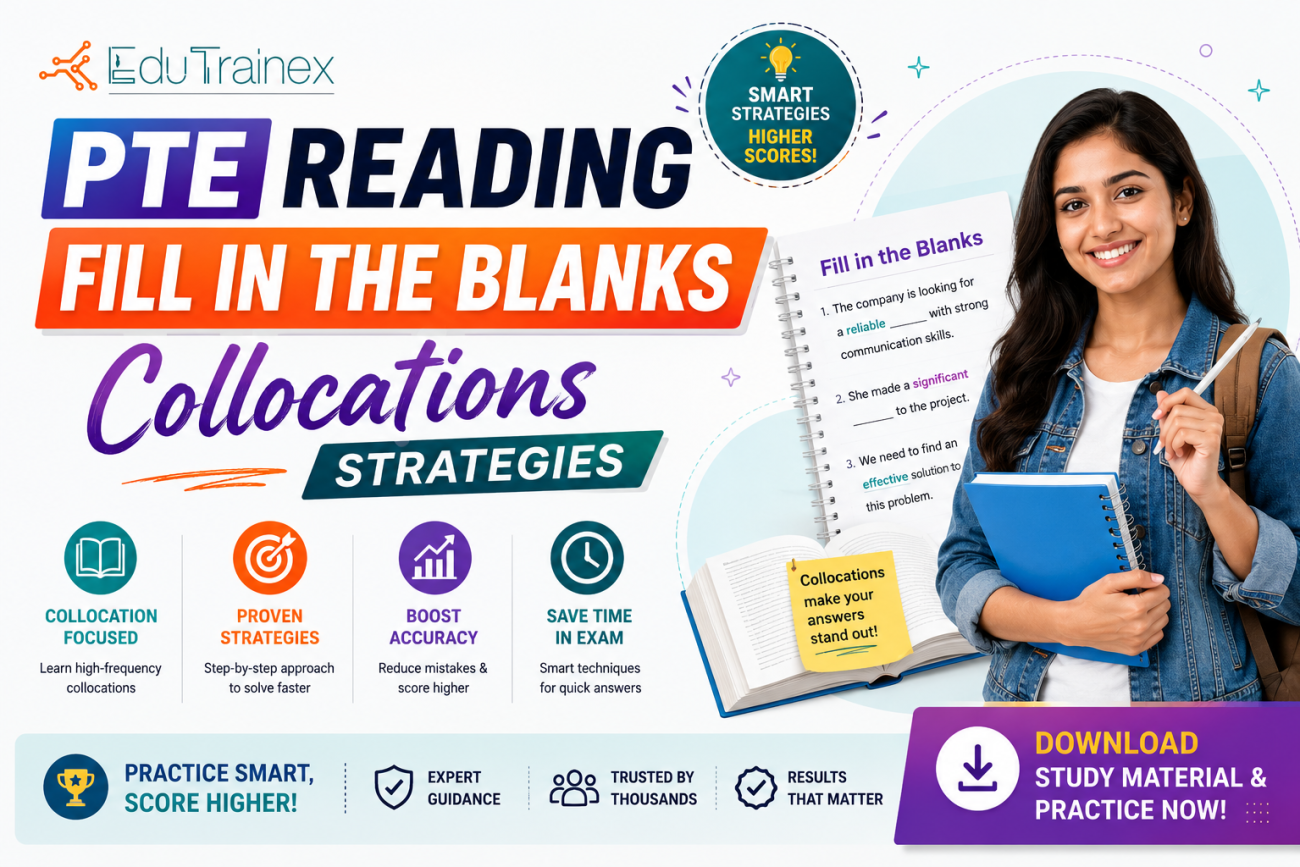
Why PTE Collocations For PTE Reading Are Important
You need good grammar as well as vocabulary to score 79+ or even 90 in PTE Reading. The skill that is considered most useful is always obtained by understanding PTE Collocations. Collocations are natural combinations of two or more words, which are generally spoken by native speakers. These are used mainly by the PTE exam in PTE Reading Fill in the Blanks questions.
Students most often prepare for their reading by only learning a vocabulary list, and they do not succeed with this strategy. There will be no question which is going to ask you to choose the correct word meaning. In your actual exam, you will get collocations that will be there to guess before and after the blank. Hence, these reasons make PTE Collocations very important for test takers.
Meaning of the text, context, grammar, and collocations are the factors on which the PTE Reading Fill in the Blanks drag-and-drop and PTE Reading Fill in the Blanks dropdown questions depend. Let’s understand with the help of an example sentence – ’ ________ session by the teacher’, then we will choose conduct as the correct answer, as conduct session is a collocation. Although we accept the fact that options could appear very comparable and even sound natural in that situation. If you know the collocation, then you will choose the correct answer.
By learning and using PTE Collocations, you will definitely reduce the time you take to prepare for your test. It is always advisable to study valuable words with their grouping rather than learning different words. For example, strong evidence, stimulate economic growth, conduct classes, and the expression of somebody. This will make you respond very quickly and very accurately with these combinations in PTE Reading.
What Are PTE Collocations In PTE Reading?
Collocations are the combination of two or more words that, when combined, sound like they are spoken by native speakers. To cite an example, we always make a mistake, not “do a mistake”. Furthermore, we always announce results, project commencement, compound interest, and evaporate quickly.
In other words, collocations are words’ partnerships as they help to sound natural and full of meaning. In PTE Reading Fill in the Blanks, collocations are very helpful because the blank is often in the middle of words that give you a hint. When you understand common PTE Collocations, you can quickly recognize the best-suited option.
For example:
- Figure out
- Granted permission
- Hard work ethic
- Keeping records
- Mandated policy
- Safety pin
Types Of PTE Collocations You Should Learn
There are many kinds of PTE Collocations, but for PTE Reading, some are more vital than others. The following types are especially useful for PTE Reading Fill in the Blanks.
1. A Combination Of A Verb And A Noun
Like raise an issue, catch someone’s attention, provide information, and pose challenges.
The organizations raise an __. (Here, we will be choosing a noun- issue)
Many scientists do __ on the different fields. (Here, do research is a collocation and the correct answer is research- noun)
The little boy catches someone’s ___. (Here we will be choosing a noun- attention)
PTE passages mainly cover topics related to science and technology, so it is really important for you to be aware of all the academic combinations. This will enable you to choose the answers correctly in the Reading Fill in the Blanks.
2. A Combination Of An Adjective And A Noun
In PTE Reading tests, you can also expect to be tested on adjective and noun collocations, such as significant impact, major impact, or major damage and environmental damage.
The car has undergone ___ damage. (Here, we will be choosing an adjective after a noun that is major.)
There was a significant _____. (Here, we will be choosing a noun as an adjective that is present before it, that is, impact)
As well as coming up in different forms, two adjectives can describe the same aspect of the candidate and seem to mean the same thing, but only one of them will sound natural with the rest of the sentence. For instance, it is common for a significant impact to be a strong academic collocation and therefore be a popular choice for forthcoming exams. If you have worked through some significant impact examples, you should recognize this one fairly easily.
3. Preposition-Based Collocations
Preposition-based collocations are extremely useful in PTE Reading Fill in the Blanks because the preposition after the blank often gives you the answer. Examples include access to, depend on, responsible for, and based on.
When you come across a sentence like “Students need access ___ quality education,” your mind should automatically fill in the blank with “to”. This instant connection makes finding the answer a lot easier and quicker. It’s all about training your brain to make those links quickly, then you can select the answers like this with confidence.
4. Cause And Effect Collocations
PTE Reading passages often explain reasons, results, changes, and consequences. This is why cause and effect collocations are important. Examples include lead to change, result in decline, cause damage, contribute to growth, trigger a response, and have an impact on.
The motivational lectures have an _____ on the students. (have an impact on)
These collocations help you understand the logical relationship between ideas in a sentence. They are very useful in academic passages and PTE Reading Fill in the Blanks questions.
5. Topic-Specific Collocations
Topic-specific collocations are word combinations related to common PTE topics. For education, you may see academic performance, higher education, and educational institutions. In the case of the environment, you might have seen climate change, carbon emissions, and environmental protection. For technology, you might have seen digital platforms, artificial intelligence, technological development, and online learning.
Learning topic-specific PTE Collocations helps you understand passages more easily and improves your overall PTE Reading performance.
How PTE Collocations Improve PTE Reading Fill in the Blanks
The biggest advantage of learning PTE Collocations is that they help you answer PTE Reading Fill in the Blanks questions more correctly. You will be able to identify the correct option when you are aware of the collocation. You will need to understand the sentence before and after the blank to fit the collocation.
Many students make mistakes because they focus only on the meaning of the options; however, in PTE Reading Fill in the Blanks, meaning alone is not sufficient. You should also check the collocation properly.
This is why collocation practice is one of the fastest ways to improve your PTE Reading score.
How To Improve PTE Collocations For PTE Reading
To improve PTE Collocations, you should not simply memorise word lists randomly. You should study collocations in actual sentences and PTE-style examples. Always make sure that you are checking the word before the blank, the word after the blank, and the overall meaning of the sentence.
A renowned free resource is the Edutrainex YouTube video on 40 Collocations for PTE Reading Fill in the Blanks. In this video, trainees can learn common collocations used in PTE-style Reading questions. While watching the video, you should note the answer word, the words before and after it, and the reason why that word fits the sentence.
You can watch the free video here:
40 Collocations Video on Edutrainex YouTube
For more structured preparation, students can also make use of the Latest PTE Collocations eBook. This eBook is available through Edutrainex YouTube Membership plans or through Edutrainex Live Classes. A collocations eBook can save a lot of time because it gives you organised PTE-style vocabulary and collocation practice in one place.
You can get access to YouTube memberships and eBooks here:
Edutrainex YouTube Membership and eBooks
For live classes and PTE materials, you can contact Edutrainex on WhatsApp:
WhatsApp for PTE Materials
Edutrainex App And Live Classes For PTE Reading
The Edutrainex App is another useful platform for improving your PTE Collocations and PTE Reading. Collocation tests are available on the Edutrainex App, which means students can practise regularly and check their progress frequently. This is important because collocations become stronger with practice.
A good study plan for PTE Reading Fill in the Blanks must include daily collocation practice. For example, you can learn 20 to 30 PTE Collocations daily, attempt Reading Fill in the Blanks questions, review your wrong answers, and revise your mistake list. With the passage of time, you will start recognising common patterns automatically.
In live classes, students can also learn why one answer is correct and why the other options are incorrect. This is very important for PTE Reading Fill in the Blanks, as sometimes two options may seem similar, but only one option matches the context and fits as a collocation.
For PTE classes and app access, contact Edutrainex here:
WhatsApp for PTE Classes and App
You can also visit:
www.edutrainex.com
How PTE Collocations Can Help You Score 90 in PTE Reading
If your target is to achieve 90 in PTE Reading, you must focus on PTE Collocations. Collocations help you to understand natural word combinations, improve your speed, and choose more accurate answers in PTE Reading Fill in the Blanks.
You should learn only those words that are in groups instead of learning a single-word vocabulary list. Focus on all the types of collocations, which are mentioned above, because those are the most repeated ones.
To practice daily, there is a need to go with the right resource, named the Edutrainex app, which provides live classes, structure, and collocation tests, and will help you to improve your confidence in PTE Reading Fill in the Blanks too. In other words, to make your preparation faster, smarter, and more effective, there is a need to learn PTE Collocations.
FAQs – PTE Collocations And PTE Reading Fill in the Blanks
1. What are collocations in the PTE exam?
Collocations are natural word combinations that commonly appear together. In the PTE exam, collocations help you to understand which words fit naturally in a sentence. For example, we say ‘make a decision‘, ‘conduct research‘, ‘have a significant impact’, and ‘have access to education’. These combinations are very essential in PTE Reading, especially in PTE Reading Fill in the Blanks.
2. Why are collocations important for PTE Reading?
PTE Collocations are crucial because many reading questions test your ability to select the most suitable word based on context. In PTE Reading Fill in the Blanks, the correct answer is often not just about grammar or meaning; it depends on which word fits naturally with the words before and after the blank.
3. How do collocations affect scores in Reading Fill in the Blanks?
In PTE Reading Fill in the Blanks, every correctly chosen blank can improve your score. If you understand collocations, you can choose answers quickly and more accurately. For example, if you know the phrase ‘economic growth’, you can easily pinpoint words like ‘stimulate’, ‘support’, or ‘promote’ when they appear in the options. Strong collocation knowledge can improve your accuracy in Reading Fill in the Blanks.
4. Can learning collocations improve my PTE Reading score?
Yes, learning PTE Collocations can improve your PTE Reading score as it helps you recognise natural academic word patterns. Many students lose marks because they know the meaning of individual words but do not know how those words are used in combination. Practising collocations daily can improve both speed and accuracy.
5. Which PTE Reading question types test collocation knowledge the most?
The two most important question types are PTE Reading Fill in the Blanks drag-and-drop and PTE Reading & Writing Fill in the Blanks dropdown. These questions often require you to choose the word that best fits the meaning, context, grammar, and collocation of the sentence.
6. What is the difference between vocabulary and collocation in PTE?
Vocabulary tells you what a word means. Collocation means knowing which words go together naturally. For instance, you may know the meaning of ‘research’, but in PTE Reading, you also need to know that we commonly say ‘conduct research‘, ‘carry out research‘, or ‘scientific research’. This is why PTE Collocations are more practical than memorising vocabulary alone randomly.
7. How can I identify collocations in a PTE Reading passage?
To guess collocations in a PTE Reading passage correctly, look carefully at the words before and after the blank. Check what the blank needs: a verb, noun, adjective, or preposition. Then think about which answer option naturally connects with the nearby words. For example, if you see access ___ education, the correct collocation is usually access to education.
8. What are some common collocations frequently tested in PTE Reading?
Some common PTE Collocations include ‘conduct research‘, ‘provide evidence‘, ‘draw conclusions‘, ‘significant impact‘, ‘major concern‘, ‘economic growth’, ‘access to resources‘, ‘depend on‘, ‘responsible for‘, ‘lead to change‘, ‘result in decline‘, and ‘contribute to development‘. These types of collocations are commonly found in academic English and are very useful for PTE Reading Fill in the Blanks.
9. How should I practice collocations for PTE Reading Fill in the Blanks?
The best way to practise collocations is to study them in full sentences, not as single words. When you practise PTE Reading Fill in the Blanks, write down the correct answer, the word before it, the word after it, and the complete collocation. You can also practise using the Edutrainex App, where collocation tests are available for daily preparation.
You can also watch the free Edutrainex YouTube video on collocations here:
40 Collocations Video on Edutrainex YouTube
10. Can poor collocation knowledge lead to wrong answers even if I know the word meaning?
Yes, this is very commonly seen in PTE Reading Fill in the Blanks. Sometimes two words may have quite similar meanings, but only one word fits naturally in the sentence. For example, strong rain and heavy rain may seem similar, but heavy rain is the correct collocation. In the same way, PTE Reading often tests natural word combinations, not just meanings that are present in the dictionary.
11. How many collocations should I learn before taking the PTE exam?
The number is not fixed, but students aiming for a high score to achieve, they should learn as many common academic PTE Collocations as possible. A good target would be to practise 20 to 30 collocations in a day and revise them regularly. To save time smartly, students can use the Latest PTE Collocations eBook from Edutrainex, available through YouTube Membership plans or Live Classes.
You can get Edutrainex YouTube Membership and eBooks here:
Edutrainex YouTube Membership and eBooks
12. What is the best way to remember collocations for PTE Reading?
The best way to remember PTE Collocations is through practice on repeat, sentence-based learning, and regular testing. Do not learn isolated words. Memorise collocations in meaningful phrases such as ‘achieve success‘, ‘major impact‘, ‘pose a threat’, and ‘contribute to growth’. Then practise them in PTE Reading Fill in the Blanks questions. For structured practice, students can use the Edutrainex App, join Edutrainex Live Classes, or access the latest collocation materials through Edutrainex memberships. For PTE classes and app access, contact Edutrainex here:
WhatsApp for PTE Classes and App
